Tuesday, May 22, 2012

Catalina 385 Review

A conservative approach to the modern cruiser


As we continue our search for a new boat we would be remiss if we didn't take a look at the new Catalina 385. Catalina Yachts moved out of its headquarters in Woodland Hills, California a few years ago, undoubtedly motivated as much by the dismal business climate for boatbuilders in this state as by the fact that the bulk of the sailboat market is nowhere near California anymore. They are now headquartered in a large and modern plant in Largo, FL where the 385 and all their other models are built.

The 385 is an interesting departure if you consider that its main domestic competitors, Hunter and Beneteau have fully embraced a modernistic approach to the styling and design of their boats while Catalina has taken a more traditional approach.  To get a sense of these differences, click on the Beneteau Oceanis 37 http://www.beneteauusa.com/Sailboats/Oceanis/Oceanis-37 or take a look at the Hunter 39 http://www.huntermarine.com/Models2011/39/39Index2011.html .

That is not to say that one design philosophy is better than the other. There is plenty of room in the ocean for all kinds of boats and I am sure that Catalina is dead certain of the market segment they are pursuing, and doing so with a good deal of success. Some may say that their designs are uninspired or stodgy, I disagree, they are inspired by a market segment that has made them arguably the most successful homegrown boatbuilder in the country. So let's take a closer look at the 385 and learn what it is that makes this company so successful.

The hull shape of the 385 is rather traditonal compared to its competition. Notice on the sailplan that bow is raked about 45 degrees and in the accommodations plan, the beam is concentrated more amidships than the Beneteau or Hunter. I don't think this is necessarily a bad thing. The trend seems to be toward boats with very wide transoms. This allows for lots of space below but does affect the sailing qualities of the boat. As the boat heels the bow is forced down and the rudder is pulled up. I think there is an optimum ratio between beam aft and beam amidships for different types of boats and perhaps Catalina feels that they've gone far enough in that direction.

The Catalina 385 shows a more traditional approach to hull design than its competitors
The rest of the exterior of the boat is nicely designed and very much in keeping with the conservative philosophy in the hull design. The cabin trunk is pure Catalina, with it's trademark windows and familiar T-shaped cockpit. Notice the vertical battens in the mainsail, indicating an in-mast furling system. In spite of the fact that practically every production builder uses this arrangement, I'm not a fan. I prefer a fully battened mainsail with slab reefing.  Catalina's conservative approach to the sailplan is carried through to the almost masthead rig with fore and aft lowers. Notice that the mainsheet traveler is at about the midpoint of the boom, with a block attached about three quarters of the way aft of the mast. This arrangement will allow for a mainsheet-free cockpit but does put a lot of load on the boom and cabin top.

Here are some dimensions:
LOA (hull):  38' - 2"
LWL: 34' - 5"
BMAX: 13' - 1"
Draft (deep keel):  6' - 10"
Draft (shoal keel):  4' - 8"
Disp. (deep keel): 15,500 LB
Ballast (deep keel):  5,200 LB
D/L (deep keel):  169
Sail Area: 676 sf
SA/D:  17.0


The T-shaped cockpit with walk-thru transom looks like a comfortable place to be. Notice the instruments. Those mounted to starboard will be hard for the helmsman to see when driving from the port side. This is a popular, if impractical, arrangement.  The problem is that you have to be sitting aft of the wheel to see them. A better arrangement is to locate them above the companionway so everyone can see them.

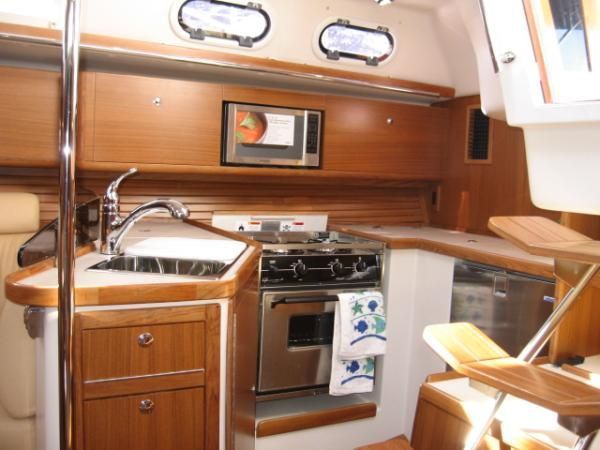
Going below, the accommodations plan carries on the conservative theme, which in my opinion is a good thing. The galley is big and well designed, with plenty of counter space and double sinks. The aft cabin features a king size bunk with plenty of storage space under, a good sized seat and plenty of locker space. Also notice that access to the engine appears to be good on the port side. I'm a big fan of good engine access. The main cabin is quite spacious. I'm glad to see that the designer didn't try to squeeze too much into this area, but I prefer a dedicated nav station instead of the small table at the aft end of the dinette. I guess this is a nod to the the fact that navigation and chart work are not very important in this coastal cruiser.

Catalina 385 galley


The head, located forward of the main bulkhead is also spacious, with access from the forward cabin as well as the main cabin. The forward cabin contains a large V-berth and plenty of storage. Once again, it's nice to see that the Catalina design team didn't try to stuff a 42 foot interior into a 38 foot boat.

Cat 38 Accommodations. Plenty of open space and a nice arrangement for weekends at the island.

The Catalina 385 is, in my opinion, a nice balance of traditional and modern design. There's plenty of living space and reasonably good performance here along with what I would call American styling. That's refreshing.

Friday, May 11, 2012

Honcho Sold

The Honcho at the shipyard, ready to be hauled out and packed up for the road trip to Anacortes.

Last Friday we finished up the paperwork and handed the keys to the Honcho over to her new owners, who will have her hauled out and trucked to Anacortes where she'll be relaunched. From there she'll sail to her new home in Sidney, BC, Canada.

It was bittersweet to see the boat go because we had such an enjoyable four years with her. But all things must end, and with the Honcho off to her new home we are ready to begin to search in earnest for our next boat, which is the first step toward new sailing adventures. We were very fortunate to have found the Honcho, a boat that had been lightly used by her previous owners. We'd like to find another boat that has had no modifications or 'upgrades' so we can start with a 'clean slate' and set it up for offshore cruising with top quality equipment.

Over the last few months we've looked at quite a few boats in person and online. We really liked a Delphia 40GT that we found in San Diego, but it was sold a few weeks before we could make an offer on it. I've reviewed several boats in previous posts here that caught my eye, but so far we have not settled on a particular make or model. At this point I would say the Beneteau 423 comes closest to what we're looking for. It seems to embody that balance of design, construction, performance, comfort and budget that we're looking for, and is the benchmark that we've been sort of measuring other boats by. If we weren't constrained by a budget I'd say the Hallberg Rassy 412 would fit the bill nicely, but of course our budget can't handle that much boat. But a boat of that ilk is what we're looking for. I'll keep you posted as we wander around the country searching for the perfect, or almost perfect boat.

Wednesday, April 25, 2012

April 14, 2012


Low Speed Chase on the rocks. I copied this photo from www.sfgate.com

LOW SPEED CHASE

On April 14th I was scheduled to go racing off Newport Beach aboard the Davidson 44, Pendragon. It was a cold and blustery day with winds gusting to 25 knots and a lumpy sea running. These are not particularly rough conditions in most parts of the world so we were a bit surprised when the race committee cancelled the event. Known for its light air and mostly benign conditions, this area is among the pleasantest places I know of for casual racing.  But when it gets nasty it’s no place for the casual sailor who is accustomed to light air and easy seas, and I think the race committee made the right decision. So instead of bashing around the buoys in foulies and PFD’s we relaxed and enjoyed the winds and whitecaps from the comfort of the slip, with cold beverages and tasty snacks for all.

At the same time, four hundred miles to our north, the competitors in the Farallones Islands Race rode an ebb tide out through the Golden Gate into building westerly winds and waves.  The race starts and finishes off St. Francis Yacht Club, leaving the southernmost Farallon Islands to port. As the day wore on the winds built to 25 knots or more with seas in the 10-12 foot range as the boats bashed out toward the southeast Farallon Islands, 27 miles west of the Gate. Rocky and primitive, these islands are usually beset by rough seas and strong winds, and on this day conditions were rough but not unusually so. In any case, rough or not, sailors are well advised to give the rocky lee shores of these islands a wide berth as they pass them.

Among the racers was a Sydney 38 called Low Speed Chase with a crew of eight aboard. The crew was apparently fairly well experienced racing in the boisterous conditions that San Francisco Bay usually serves up, and at least one had some serious offshore miles under his belt. As the boat worked its way westward on starboard tack past the westernmost point on the island, they began to ease sheets and bear off around the weather side of it, seeking to save some time by cutting in close to the shore. Believing they were outside the breaker line, the Low Speed Chase was caught by an outside wave that broke over the boat, washing most of the crew overboard, snapping the rig and stripping the deck of the safety gear that was mounted there. Before the crew had time to react another wave broke over the boat, eventually washing it and one crewman who managed to stay aboard onto the rocky shore. Two other crew managed to scramble onto some rocks while the body of the fourth was found floating in the water nearby. The other four members of the crew have not been found and are presumed dead.  The boat’s EPIRB activated automatically and in a short time the Coast Guard was on the scene and rescued the three survivors and recovered the body of the fourth victim. It is impossible to overstate the heroism and professionalism of the Coasties, who regularly go into extremely dangerous situations to save lives as part of their daily routine.

I don’t know all the facts surrounding this tragedy and I may be wrong about some of the details, but basically the story is that the Low Speed Chase rounded the weather side of the island too close inshore, was caught in breaking waves and was lost. It is with considerable sorrow that I write these words. Not just because of the tragic loss of life, but also because those who were lost shared something fundamental with me. They loved the sea. In other words, while I was not acquainted with them, I know their kind because I am their kind and so are the people most dear to me.

The loss of the Low Speed Chase is a reminder that the sea, for all its beauty and for all the awe and wonder it inspires in us, is pitiless. Those of us who choose to play here and wander upon it cannot for an instant forget that first and foremost we must respect its power. It is not for me to criticize or lay blame. The lives of all who were involved in this tragedy along with their loved ones have been shattered and will carry this catastrophe with them as long as they live. At the same time, we can take heart in the fact that those who lost their lives left this world doing something they loved.

There are many lessons to be learned from this tragedy and I’m sure much will be said and written about what the crew of the Low Speed Chase should or should not have done. Ironically, my guess is that the armchair sailors of the world will express most of those opinions. But one thing those of us who spend our time racing should learn is that it’s not enough to be a great helmsman or tactician. Nor is it enough to be a great trimmer or bowman, or be possessed of great knowledge of the rules or other aspects of the sport of yachting. We must also be good seamen. Whenever we venture from the dock, whether for a Sunday sail, a race round the buoys or a long offshore passage, we have to be prepared, and armed with respect for the sea and its power, for it is not to be trifled with.

DON ANDERSON
On the same day, we lost another pillar of the yachting community. Don Anderson began broadcasting weather information on SSB radio nets in the late 1990’s. A true offshore sailor, he and his wife made many passages in the Pacific aboard their Valiant 47, Summer Passage, and during those years he became an expert on the weather as well as a ham radio operator. His weather forecasts and advice on the Sonrisa net and others were geared toward sailors along the Pacific coast of Mexico and Central America and out to Hawaii and the Marquesas. A true curmudgeon in the best sense of the word, he sprinkled his weather reports and forecasts with his acerbic wit. Not one to suffer fools gladly, he was never at a loss for words and gave many a sailor an earful of good advice whether they asked for it or not.

It was always a treat to tune in to Don’s broadcasts and I will miss them, especially during passages along the coast of Baja California. These days we have many high tech resources for gathering information about weather and sea conditions, but somehow they don’t compare to Don’s expert advice on that stretch of the ocean.  

Saturday, March 31, 2012

Hallberg Rassy 412 Review

A sophisticated Cruising Yacht
It was about a year ago that I heard Hallberg Rassy was developing a new aft cockpit 41 footer. Long known for their center cockpit boats, it seems that the venerable HR firm has made a commitment to this style, at least for their smaller models. I think a center cockpit boat needs to be at least 45 feet long to be truly good looking and practical, so in my opinion this is a healthy trend for them. If you visit the Hallberg Rassy web site (www.hallberg-rassy.com), which is where I got my information about this boat, you'll find that they now have a line of aft cockpit boats ranging from 31 feet to this new 41.

The HR 412 was designed by German Frers. Best known for his superyachts and Swan yachts, you might think Frers is an odd choice for a company that in the past has built its brand with fairly frumpy small center cockpit cruisers. I think it's an excellent choice because of all the designers they could have chosen, Frers is one who could imbue this type of boat with that ineffable sense of grace that has been his trademark throughout his career. That is evident in this newest HR and in the recently launched HR 64.

Let's start by taking a look at how this boat might perform. We can deduce a lot from looking at the outboard  profile and deck plan, which will give a good idea of the shape of the hull. Combine this with the boat's hull and rig dimensions and we can create a good estimate of what to expect from the HR 412 in terms of sailing performance.
Notice the long waterline, wide stern and the step-thru transom. With its tall rig, deep keel and powerful rudder, this boat  should be a fast passagemaker.

Here are some numbers:
LOA ................ 41.42'
LWL................ 37.75'
BMAX............. 13.50'
Draft................. 6.58'
Sail area............ 970 sq ft
BAL/DSP......... 36.2%
SA/DSP........... 18.45
DSP/L.............. 202

Heavy construction, deep bilge sump, powerful spade rudder.


Interpreting the numbers tells us that with a displacement/length ratio of 202, it is a bit heavier than most racer/cruisers  But the tall, 3-spreader rig and sail area/displacement ratio of 18.45 provides plenty of horsepower even for relatively light air. We can surmise from the distribution of volume below the waterline that the prismatic ratio is in the .54 range, which is fairly conservative. I would guess that there is plenty of flare in the aft sections of the hull so the boat will be well balanced when heeled in a breeze. With the stem angle at about 14 degrees from vertical, I'm confident that the bow near the waterline is finer than many cruising boats. Couple these features with the deep bulb keel and you have a package that will sail well to weather, with the weight and horsepower to punch into a head sea. The big mainsail and small jibs will enable the boat to reach at high speeds and if you noticed the masthead spinnaker, you know this boat will be quick downwind as well.

Going on deck, we find Hallberg Rassy's trademark windshield wrapped around the forward end of the cockpit. Way up north where they build HR-412, that windshield is a requirement for cruising, but given how much thought they have put into the design of this boat, I would like to see a bit more finesse in the windshield in the form of  some radii where the sharp corners are. I like the simple but efficient geometry of the cockpit, with its long seats and broad coamings. I also like the step-thru transom. This is an important convenience for getting aboard from a dinghy as well as fishing...all essential activities for cruisers.  The 412 sports non-overlapping jibs but fortunately eschewed a transverse jib track on the cabin top. This makes for a more versatile sailplan and reduces clutter on the foredeck. Aboard the Honcho, I had to modify the stemhead to accommodate a Manson anchor. This type of anchor is a vast improvement over the plows and danforths of yesteryear, so builders should make accommodations for that type of anchor.

Notice the Saildrive. They are becoming commonplace even on cruising yachts. This one is fitted with a three blade folding prop.


Hallberg Rassy offers a wide range of interior options so I scrolled through the various plans and chose the one I think works best for a cruising couple. Forward is a large stateroom with plenty of storage space and a private head. The head includes room for a washer/dryer, very convenient. The main salon includes a basic settee and dropleaf table arrangement. The settees are are big enough to serve as sea berths if fitted with lee cloths. There are deadlights in the hull adjacent to the settees, which add light and visibility. The galley, to port, is adequate but not enormous. A nice touch is the optional separate freezer. Opposite the galley is a smallish nav station. When you're on a cruise, the nav station serves many purposes aside from navigating. It is a desk, work table and sometimes an extra galley counter, so I like mine to be big, with a comfortable seat and plenty of room for all those small things that always find their way into the chart table and adjoining lockers.

Aft of the nav station is another head with space for a shower stall.  This will be a great place to hang wet foulies


I like this boat. It meets all my criteria for a good, solid, fast cruising yacht. I give it high marks for striking a finely tuned balance of performance and comfort. Aesthetically, the overall proportions of the boat should be pleasing to the eye, and that's important. Some might criticize the 'springiness' of the sheer on the 412. I think a little more tautness there might improve the boat's looks, but I'll reserve judgement on that until we see the boat. Sometimes what looks good on paper doesn't work out as well in reality.

The Hallberg Rassy 412 is scheduled to be launched later this year. I would put this on my short list of must-see boats.

Thursday, March 1, 2012

Hanse 415 Review


The new Hanse 415 has just recently been unveiled in Europe and will soon arrive in the USA. It is an all-new design by the firm of Judel-Vrolijk, which has a long string of successful racing yachts, as well as a number of production cruising yachts to its credit. The 415 follows the decidedly Teutonic styling of the other yachts in the Hanse lineup and I think there will be many who really like it, while others may find it a bit too quadrilateral. I fall into the second category.


Hanse 415

With its 13'-8" beam and 20,000 LB displacement, the Hanse 415 has a big, buxom hull with a plumb bow and nearly vertical transom. It’s a beamy boat and that beam is carried well aft. In fact, it’s nearly as wide at the transom as it is at the Bmax point. This hullform is becoming more common in cruising yachts and I think it makes for a very fast hull, but could be a handful to steer in quartering seas. Of course it provides a great deal of interior volume and that is probably an acceptable trade-off. The firm bilges, high freeboard and nearly flat sheer add to the visual bulk of the hull, but those factors also contribute to interior volume. Again, it’s a matter of balancing performance, accommodations and aesthetics. 

The keel and rudder of the Hanse 415 are deep and efficient foils and the torpedo shaped bulb is massive. I question the wisdom of such a keel on a cruising yacht. Snagging longlines, kelp and other underwater obstacles is not uncommon in many cruising grounds. More than once we sailed over or around them while cruising in Mexico and I would recommend not having such a keel if you’re headed south. Fortunately Hanse offers a more practical shape in their shoal keel.  I must say the bow thruster will be handy for the shorthanded crew when you’re trying to shoehorn your new 415 into a tight berth.

Notice the retractable bow thruster.


The profile view of the 415 shows a nicely proportioned cabin trunk.  The ports in the topsides provide light and a nice view from the salon, but there is no disguising the high freeboard. Notice the split bow pulpit, traditionalists may object but it is much more practical than the old style pulpits.

The sailplan of the 415 is excellent for cruising, especially if the main carries full battens and a ‘stackpack’ system as shown in the drawing, although I prefer the battens to be parallel to the boom so they fall perfectly into the pack when dousing or reefing the main. On the other hand, I’m not so fond of the bridle system in lieu of a real traveler. You can tweak this system to drive hard upwind, but a traveler is easier to manage.  I struggle with the idea of mid-boom sheeting. It’s not efficient, it requires lots of muscle, and it puts enormous loads on the boom and cabin top. On the other hand, it allows for a full dodger-bimini arrangement, which is very desirable in the tropics.

All of my recent designs have outboard chainplates, which limits the headsails to about 105%.  The Hanse 415 also incorporates this feature. The working jib on this boat actually sheets to a traveler just forward of the mast so it can be self tacking. I like that, as long as there is enough horsepower there to make the boat go in 5-8 knots of wind. Fortunately, the sailplan also shows a slightly larger headsail that sheets to tracks mounted on the cabin top. Self tacking is cool, but I prefer pulling in a bit of jib sheet on a slightly larger jib.

Hanse 415 carries its beam well aft. 


Judel and Vrolijk did a nice job with the cockpit. The very wide beam aft allows for spaciousness and sailing efficiency. Twin wheels mean that the helmsman can sit well outboard and drive the boat like Cayard while the rest of the crew relaxes in comfort behind the dodger. The cockpit seats are nearly long enough for a snooze and the cockpit table is big enough to manage all the refreshments the cruising crew might desire. Alas, the coamings, which appear to be broad and comfortable, are not. Someone down at Hanse, or possibly in the JV office thought it would be a good idea to lead the halyards and lifts right over the coamings to a gang of rope clutches at the back end of them. This was done ostensibly to make working the vessel more efficient for a shorthanded crew. Unfortunately this is a mistake. People sit on coamings. They put their drinks on them. They stand on them and use them for all manner of other purposes. If Hanse absolutely has to have those lines led aft to the back end of the coamings, why not put a cover over them?  As they are now, they are worse than useless.

Inconvenient cockpit coamings, but a nice back porch

The rest of the deck plan is fairly well thought out. There is a good-sized anchor locker with what appears to be a stout bow roller up forward. Again, I am amused that Hanse thoughtfully provided covers over the halyards and lifts on the cabin top, but not on the coamings. I wonder what they were thinking.

Let’s go below. Hanse offers a plethora of alternatives in the accommodations plan and I studied them all and chose the one I like best. It incorporates a large forward cabin with plenty of room to maneuver and storage space. The berth is pushed so far forward that it is quite narrow at the pointy end. I’d prefer to have it another 6 inches aft. This would allow for a larger anchor well and a more spacious berth at the cost of some closet space.

One of many possible accommodations plans.


The main cabin offers a spacious dinette to starboard and settee/desk to port. This apparently doubles as the nav station as well. I’m not fond of this arrangement. I think any yacht this size should have a dedicated nav station. It should have a good size chart table, plenty of space for navigation and communications equipment, and a comfortable seat. I also prefer it to be near the companionway.

Spacious Galley

The galley is spacious, with lots of counter and storage space. For a crew of two or three a single sink might be adequate, but I would prefer a double sink. Like the rest of this boat, the galley appears to be well finished with satin-varnished wood and faux granite counters. But the sharp corners and square lines remind me more of an apartment that a sailboat. This squared-off theme is carried throughout the boat and, while it’s clean-lined and simple to build, it seems a bit cold and uninteresting to me.

Designer appointments in the head.


I really like the large cargo hold aft of the galley. It is accessible from there and I presume from the cockpit too. It appears to have a small workbench and  space for sails, spares and other gear. This kind of space is very valuable on a cruising yacht.


The head is spacious and includes a separate shower stall. I like the location near the companionway, and that shower will make for a convenient wet-locker at sea. The apartment house theme is evident here, with the designer washbasin and lack of fiddles on the rather large counter.


Aft of the head, the large quarter-cabin incorporates what looks like a king-size berth and plenty of storage space. Notice the companionway steps. The engine lives under and behind them. It looks like access to the engine compartment is excellent. This is another thing that is very desirable on a cruising yacht. Easy access to filters and pumps is vital because you very often find yourself having to service them while underway, and it’s annoying at least, and possibly dangerous when the only real access to the engine involves moving the companionway steps.

I like this boat and think that with a few modifications it could be a comfortable cruising yacht. While the interior styling doesn’t work for me, for those who prefer a more cosmopolitan living environment, it could be just the ticket.

Sunday, January 29, 2012

Beneteau 423 Review

One thing we noticed while on our cruise in Mexico is that people cruise aboard an astonishing variety of boats, from sophisticated luxury yachts to clunky old wooden double enders, and all manner of boats that lie somewhere in between those ends of the spectrum.

On a scale of one to ten, with one being the luxury yacht and ten being the wooden double-ender, we are looking for about a number five: Our next boat will have some luxury but not too much, and be reasonably priced but not cheap in any way. We want a boat that is big enough to be comfortable but not too big for a couple to handle. We want it to be fast and weatherly under sail, yet capable of motoring three hundred miles. It should be good-looking and not too deep of draft, nor too shallow. We want a solid boat that can stand up to a blow, yet is not so heavy that it’s no fun to sail. We want a boat with a good engine and a simple and reliable rig. Down below, our boat should have a nice, big galley with a reefer and a freezer. We want a big double berth with plenty of ventilation and we want at least one good sea-berth that’s snug and warm in all conditions. We want a head with a separate shower and plenty of crystal pure hot water. We want a boat that is easy to operate and to maintain. Finally, we want a boat that's beautiful inside and out. In other words, we want our ideal boat. Over the last year we've spent a good deal of time searching the Internet, walking docks and studying new boat brochures.  We have settled on a length of 40 to 44 feet as the optimum and have a few boats on our short list of contenders. Let's see if the Beneteau 423 makes the cut.


In my opinion Yachtworld.com is by far the best place to look at boats without actually going aboard them and it is from there that all of the photos in this review come from. As of today, there are 25 of these boats listed there, all built between 2003 and 2007 and ranging in price from $159,000 to $293,000. 


Beneteau 423. 
Cruising is to a large extent about living aboard your boat in exotic, or perhaps not so exotic, places. So I thought I'd start with the living spaces on this boat. Beneteau offered a two cabin and a three cabin layout in the 423. The three cabin version appears to be designed for the charter trade with the galley arranged lengthwise along the port side of the main cabin. I think this makes it unsuitable for passagemaking so I'm going to focus on the two cabin version, which is the only one we'd consider buying.

B423 Two Cabin Version
I really like this arrangement. There is a spacious owner's suite forward of the main bulkhead that includes a head with separate shower stall, plenty of storage space and a big double berth. The berth has storage space under it and the top is hinged and fitted with gas springs to make it easy to lift, making all that storage space is easily accessible.

The salon includes a storage locker above the forward end of the port settee. Several of the 423's we looked at had flat screen TV's mounted there which was convenient for watching while lounging at the dinette. The table can be lowered, converting the dinette to very nice double berth. There is a seat opposite the table with a hinged lid. One of the 423's we looked at had this area converted to a wine cellar.  The Honcho has small windows in the hull that provide a surprising amount of visibility. The 423 has a pair of good sized windows adjacent to the dinette area, providing a good view of the outside world from the settees.
TV works better mounted above the forward end of the port settee.  The three skylights have shades, a must in the tropics. 


The galley is large enough for a true long range cruising yacht, with plenty of counter space and room for a microwave oven. This is one of the few boats of this size that features a top-loading freezer and a separate front loading refrigerator, making life in the galley much easier. Along with the big reefer/freezer, the 423 features substantial pantry space so finding room for a couple month's provisions is not a problem. Overall, I give this galley high marks.
Lots of light, space and ventilation in the galley.


The nav station, opposite the galley, is rather small but well designed. There is room for a laptop, radar, VHF and SSB, along with a bank of breakers for the electrical system. Aboard the Honcho we used a Garmin 440 plotter in the cockpit and a laptop with Maxsea software connected to a GPS receiver in the nav station. These worked well but in Mexico they both interface with what are essentially digital versions of paper charts. The GPS can locate the boat within a few feet of its actual position, but then overlays that position on charts that were created before the advent of satellite photography and are not always accurate, especially with regard to longitude. We found that our I-Pad with Navionics software was superior as it projected our position onto perfectly accurate satellite earth photos. Very cool.

Aft of the nav station is another head with access to the aft stateroom as well as the main cabin. The quarterberth is cavernous. Since there isn't a good sea berth in the main cabin, I'd rig a lee board in this berth to create a snug place to sleep while under way. Though there are sleeping accommodations for only two couples, I think that's about right for a boat of this size.

Clean lines and nice proportions.

I like the design of the deck of this boat much better than the current offerings from Beneteau. The new boats are, to my eye, not very pleasing to look at. The 423 has a low, well proportion cabin trunk and a large and well designed cockpit. Never a fan of built-in cockpit tables in the past, I find myself liking them more and more if they are well designed and don't hinder the crew too much. Let's face it, we're not going to be short-tacking up to a weather mark, or engaged in jibing duels in this boat. Tacks and jibes will invariably be casual affairs in a boat like this so the table shouldn't be a problem. The cockpit itself is spacious and well designed for relaxing as well as sailing. There is a step-through transom with a large swim step equipped with a shower. Fishing is important and that swim step will make getting a fish aboard fairly easy.

Big cockpit. Here the drop-leaves have been removed from the table.

The Beneteau 423 is a fairly husky boat, which is a good thing for a cruising yacht, with a long waterline and a moderately shallow canoe body. Notice in the accommodations plan above that it is rather full in the bow and carries its beam well aft, resulting in a wide and powerful stern. Here are some numbers:

LOA:         43'-2"
Beam:        12'-11"
Draft:         6'-11" (deep keel)
Disp:         19,797 lb
Ballast:      5,865 lb
Sail area:   860 sq ft
SA/D:       18.8
D/L:          154

As you students of yacht design know, the SA/D (sail area/displacement ratio) is an indicator of the power in the rig relative to the weight of the boat. At 18.8, this is a moderately powerful rig which would provide reasonably good performance in light air, yet is not so large as to be difficult to handle in typical tradewind conditions. The D/L (displacement/length) ratio is interesting. At 154, the B-423 is considered a moderately light boat. But in studying the hull, the fullness in the ends of the boat combined with the relatively shallow hull (not including the keel), along with the powerful stern indicates that the 423 has a fairly high prismatic ratio (Cp). The prismatic ratio is an indicator of the hull shape. Without getting too technical, we can say that a high Cp is indicative of a boat with more wetted surface, resulting in more parasitic drag than a boat with a low prismatic ratio. On the other hand, it would also generate a flatter wake, that is to say smaller bow and stern waves as it passes through the water. This is referred to as induced drag or wave-making drag. All of this means that the Beneteau 423 might be a bit sticky in light air, but should trundle along quite nicely at or near it's hull speed in a bit of a breeze. I want a boat that handles well and shows good speed when the wind is up, and I'll take the trade-off of possibly motoring more in light air.
This is a long, fairly slender boat for a cruising yacht. The displacement is pushed out toward the ends of the hull and the ballast is concentrated near the bottom of the keel. This boat will show a good turn of speed in a breeze.

Notice the sailplan of the 423. It is fairly short with a long "J" and "E" dimension. This is not what you'd choose for a racer but I think it's a good compromise for a cruising yacht. The main traveler is on the cabin top so the dodger and bimini can be deployed all the time, whether at anchor or under sail. In the tropics protection from the sun is vital. The mid-boom sheeting is not as efficient as end-boom, so you'll want powerful winches and at least 6:1 purchase on the traveler and mainsheet. If those controls are not easy to adjust, they won't get adjusted much and overall performance will suffer.

The long, uncluttered foredeck will be handy for carrying a dinghy and the big anchor locker can handle plenty of chain and rode. I'm a fan of oversize ground tackle and will outfit our next boat, as I did the Honcho, with a powerful windlass and big anchors. I think the overall proportions of the deck, coupled with the moderately sprung sheer and short overhangs give the B-423 a respectable, offshore capable appearance. We've been aboard several here in southern California and were pleased with the looks, quality of construction, and engineering of this boat and have added it to our list for serious consideration whenever the Honcho sells.




Saturday, December 24, 2011

Summit 35

Summit 35
Nice Profile


One of the best things about being in the market for a new boat is checking out the newest designs, going for test sails and pondering cruising to distant places or collecting trophies. When I started looking at the Summit 35, I quickly forgot about the distant coves and palm trees, and instead, thought about racing and collecting pickle dishes.

Mark Mills designed it for Summit Yachts and Edgewater Boats builds it in Florida. The Summit 35 is really a buoy racer with enough accommodations for a couple to spend a week or so cruising, or for longer coastal races. Mills describes the boat as being designed to excel under the IRC. The IRC is a handicapping rule that is in some ways like PHRF and some ways like other measurement rules such as the now defunct IOR rule. I say that because to get a rating you must have your boat measured or have the builder certify the dimensions of the boat. Then you submit all the required information to the Rating Authority, which has a secret formula that they use to calculate the boat's handicap rating. The PHRF aspect comes from the fact that the Rating Authority may use subjective judgments as well as the boat's measurements to give a boat a final rating. The idea behind the secrecy of the rating formula is that designers and builders aren’t supposed to know what it is and therefore can’t tweak their designs to take advantage of the rule. Some of you may recall the goofy designs that came out of the IOR rule, where speed producing factors were penalized and credit was given for speed reducing factors.
The S-35 has a displacement of 10,930 lb with 5,300 lb of ballast, most of which is in that massive bulb.

Enough of the handicapping jargon…Let’s just evaluate the Summit 35 based on common sense. I should say out front that I haven’t had an opportunity to sail one yet and all the information I have on the boat was taken from Summit-yachts.com and yachtworld.com. I like the overall proportions of this boat. The very slightly raked stem and transom make the hull more visually attractive than if they were vertical, as does the slightly sprung sheer. Below the waterline we see a fairly shallow hull with a narrow waterline beam and lots of flare in the topsides. The keel consists of a vertical fin with a slightly raked leading edge coupled to a massive lead bulb. Notice in the photo that the bulb extends a long way forward from the fin. There doesn’t appear to be a kelp cutter on the keel so that bulb could be a problem in areas with lots of kelp, like southern California. On the other hand, the bulb will keep the boat on its feet in a breeze.
Big cockpit, square corners and German mainsheet system

I like the deck on this boat. It has a beautiful cabin trunk and a nice big cockpit with seats forward and plenty of room for the crew. The options list includes twin wheels instead of the standard tiller. I would choose that option in spite of the extra weight and cost. The wheels are smallish, but allow the helmsperson to sit well outboard, and leave plenty of room for the crew. Notice that the main traveler is located well aft on the cockpit floor, with the sheet led forward along the boom, then down under the deck and back to a pair of winches just aft of the short cockpit coamings. This arrangement is known as a ‘German’ or ‘Admirals Cup’ system. With 2:1 purchase and the ability to trim the main quickly, it can be an excellent arrangement for a racer, and has some benefits for the cruising yachtsman who understands the strengths and weaknesses of this system. On the Summit 35 with tiller steering, the helmsperson sits forward of the main trimmer, on or outboard of the coaming, with the main trimmer sitting aft. It doesn’t look too comfortable for the helmsman. With wheel steering, the helmsman will be aft of the main trimmer, but it’ll be a tight fit for the trimmer. This will be fine on the upwind legs, but could get complicated on the downwind legs jibing in heavy air and at the leeward mark where the main trimmer will be ripping in the mainsheet and the helmsman is busy getting around the mark and avoiding flying elbows and mainsheet tail.  It’s not a big deal, but will take some practice for the helmsman and trimmer to work out how to do their jobs without getting in each other’s way.

In studying the cockpit, notice that everything is pretty well squared off and all the edges and corners have roughly the same radius. There is nothing wrong with this and it is quick to tool straight lines and squared edges, but this very nice looking overall deck design could have been more artfully sculpted. Of course boats have a way of getting prettier if they win a lot of races, and I have no doubt that the Summit 35 will do that.
Compact galley is suitable for sandwiches and MRE's


It’s hard to fault the interior of this boat. The layout is just about perfect, with a good sized galley and nav station as well as a positively luxurious head for a boat this size. The interior drawing shows a big dropleaf table in the main cabin, but I'm sure few Summit 35’s will sail with it, as it looks heavy and takes up space needed for packing chutes. The galley is fitted with a gimbaled Origo two-burner alcohol stove. This is a very good unit that eliminates the need for a gas bottle and its attendant locker, solenoid, etc. While the galley is too small for cruising, it’s quite adequate for the racing crew that expects sandwiches and MRE’s instead of ‘meals’.

I was surprised to see that the Summit 35 is equipped with an aluminum mast instead of carbon fiber. This may be due as much to the IRC rule as to economic considerations. The boat carries non-overlapping headsails and can be fitted with symmetrical or asymmetrical spinnakers. There are some advantages to symmetrical spinnakers in tactical situations, especially at the leeward mark, but these are outweighed by the simplicity and efficiency of asymmetrical kites. Unless you plan to race your boat under IRC rules, which apparently favors symmetricals, you’ll want to set your Summit 35 up with a short bowsprit and asymmetrical kites.

If I were in the market for a racer, I’d consider the Summit 35. It’s a nice looking and fast boat with reasonable accommodations and, inspired by Barry Carroll, a good pedigree. I like the fact that it’s built here in America. I think that, regardless of whether the IRC rule really gains much traction in the USA, the S-35 will be a very effective PHRF racer as well. It's interesting to compare this boat to the J-111. It's very close, but I think I like the J just a little bit more. Of course neither is well suited for the kind of cruising we're planning, but it would be interesting to see these boats matched against each other in a buoy race and in a long distance race.

Inasmuch as we're in the market for a used cruising boat, my next review will be the Beneteau 423. In the meantime I invite you to visit www.summit-yachts.com if you'd like to learn more about the S-35.