Monday, August 27, 2012

X-Yachts XC-38 Review

Over the last thirty years or more, X-Yachts has created a reputation for building fast, high quality sailboats that have won major regattas in both the old and new worlds. In recent years they have broadened their product lines to include all-out cruising yachts, as opposed to the racer-cruisers they have built their fine reputation on. I think Niels Jeppesen has been the chief designer for the company since it was founded around 1979, and he has produced a long and successful string of what I consider conservatively aggressive sailing yachts. Their cruising boat line carries the designation "XC" and the  XC-38 is the smallest in that line.

XC-38: Conservative proportions coupled with a powerful rig.
 I've always liked the juxtaposition of conservative and aggressive characteristics that Jeppesen and his team instill in their products and this 38 footer is an excellent example of their thinking. With its relatively springy sheer and conservative cabin trunk, beefy hull and aggressive rig, the XC-38 looks like a fun, yet serious cruising yacht. It is, to my mind, unfortunate that we don't see more of this type of boat on the west coast of the USA. In studying the profile view above, notice the depth of the hull and the proportions of the underbody. My guess is that the hull incorporates "V" shaped sections instead of the the more often seen "U" shaped bottom. Couple this with the efficient keel and deep rudder and you have a hull that will be especially fun to sail upwind. Here are some stats:
LOA:            37.99'
LWL:            34.06'
BMAX:         12.50'
Draft:               6.50'
DISP:            19,621 LB
BAL:               8,448 LB
SA:                     865 SF
BAL/DISP      43%
D/L ratio:        221
SA/D ratio      19

These numbers are indicative of  boat of moderate proportions and good manners.The keel and rudder are deep and efficient shapes for cruising. These days there is no shortage of stuff in the water to snag and foul keels and rudders. You only have to dive overboard to free the keel from nets, pots or kelp in the middle of the night a few times to appreciate clean and streamlined appendages on your boat.

Big cockpit, artfully curved windshield, conservative lines.

On deck you'll find simple lines forward without any fancy flourishes. The foredeck is flat and uncluttered, with an anchor locker and deck mounted windlass. The nearly plumb bow requires a bowsprit of some sort so the anchor rode doesn't rub the finish off the hull when at anchor.
Clean lines forward and an A-frame bowsprit
The sailplan incorporates non-overlapping jibs. I've designed a number of boats with this type of rig and it's great for windward/leeward racing. It's not as good for reaching because when you ease the sheet on this type of jib, the top of the sail opens up much more than the bottom so you end up reaching with the lower part of the jib over-trimmed to keep the top from flogging. One solution is to set up outboard leads for the jib and that's what I'd do on this boat if I owned one.

Twin wheels, trapdoor transom and artfully curved windshield.
The cockpit on this boat incorporates nice, high coamings and twin wheels along with a curved windshield. This arrangement invites comparisons with the Hallberg Rassy 412. Notice the instrument console on centerline, with a dropleaf table incorporated into it. This is an acceptable arrangement for daysailing but not very good for passage-making, although it is redeemed somewhat by the instrument displays built into the forward cockpit coaming. The fact is that cruisers spend little time behind the wheel when on a passage, so locating vital displays back there is inconvenient at best. Aboard the Honcho we mounted the GPS on a swivel just forward of the binnacle so you could see it from anywhere in the cockpit. We also traded the Raymarine instruments for TackTick wireless units, which could be mounted anywhere we wanted them, even below. Our Beneteau 423, Finisterra, came with the Raymarine instruments and, reliable as they are, we've already replaced them with Tackticks. Another unfortunate aspect of this cockpit is the permanently mounted dropleaf table that bisects the cockpit. Again, we have this arrangement on the Finisterra and find it to be inconvenient when sailing. I've already started designing a stowable table that will give us room to maneuver while under sail and still provide fine dining accommodations in the cockpit when we need them. Notice the nearly vertical transom. It sports a drop-down panel and gate to make a swim step or platform. I think a reversed transom with a molded-in swim step is preferable because it is so much more convenient than this arrangement. It would also increase the sailing length of the boat and reduce turbulence at the  transom.

Nearly perfect accommodations plan

X-Yachts offers only one interior plan in the XC-38, which is fine with me because it works really well. The forward cabin is spacious and incorporates a large V-berth, multiple lockers and cabinets, and plenty of light. Those windows built into the hull look small but provide a good deal of light and visibility. The settees in the main cabin are big enough to serve as sea berths. With the galley, nav station and head aft, the crew that sleeps in the main cabin won't be disturbed when you go below to check the chart or fix a cup of coffee during the midnight watch. The galley is large, with lots of counter space and double sinks amidships. I respect the designer's decision to eschew a second head on this boat. One is plenty for the cruising couple and this one incorporates enough room for a shower as well. The aft cabin offers a good sized berth and plenty of storage. In studying the photos of the boat on the X-Yachts web site, it took some time to get used to the horizontal grain pattern on the furniture. I'm not sure I like it yet, so I'll reserve judgement until I see a boat in person.

Overall, I think the XC-38 would make a very good medium sized cruising yacht. I'd ask for that reverse transom and swim step if I ordered one but other than that, this boat is ready to cruise.

Saturday, August 4, 2012

Rig Conversion Update

We stepped the new mast a few days ago. The whole operation went without a hitch, except for the actual delivery of the mast, which was shipped from US Spars in Gainesville, FL. The trucking company, called "Big Dog" is not one I would use again. The driver picked up the mast around July 1st and told me it would arrive on the west coast on the 5th or 6th. Well, that day rolled around and the mast didn't show up, and when I called the driver he said he'd be there in three or four days due to some sort of family complication. Another three or four days roll by and I called him again. Well, more complications and blah, blah, blah and it'll be a few more days. So I rearrange my schedule again and sure enough, when I got through to the driver, "yada yada yada, a few more days". The thing finally arrived about three weeks late, but the driver entertained us with the most horrific story of tragedy and travail on the road...Bottom line, Big Dog no bueno.

Anyway, the mast was in good shape when it arrived, and making the swap was pretty easy, and done in a couple of days. I brought the boom home and converted it from a roller furling type to a real boom with an outhaul and three reefs. It's about ready, but first I have to install the Tides Marine sail track system, which I'll get done next weekend. The new mainsail, a dacron unit with full battens, was delivered this week from Elliott-Pattison and I have the lazy jack system nearly ready to install. We're still getting bids on the "Stackpack" and expect to make a decision on it in the next couple of weeks.

As of today, the costs look like this:
Mast with optional equipment................ $3,500
Shipping cost........................................ $2,300
Yard bill for swapping out the mast........ $1,570
Converting the boom..............................$   100
Tides Marine sail track system................$1,250
Full-batten dacron mainsail.....................$3,000

Subtotal...............................................$11,720

We still have to purchase the Stackpack bag, lazyjack materials and reefing gear, which I estimate to cost around $1,200.

You may ask if it's worth upwards of $14K for what amounts to nothing more than converting the roller furling mainsail to a classic type. I think the answer would be different for everyone. For us the answer is an unqualified 'Yes' because we'll be able to SAIL to weather, reef the main on any point of sail, and rest assured that we'll never get caught out with the mainsail stuck.

Photos coming soon.


Tuesday, July 10, 2012

Emerald Bay

We headed over to Catalina Island's Emerald Bay last week, expecting lots of activity for the Fourth of July holiday. This was the Finisterra's first voyage to our favorite cove. We left the marina in Long Beach at 1500 and tacked up the harbor toward Angels Gate in light air. The UV cover on the jib let go after four or five tacks at the spot where it rubs on the mast mounted radar antenna, so we looked a bit ragged as we passed through the Gate, with a foot-long tatter trailing off the leach of the jib, but the boat sailed well until we ran out of wind. We motored the rest of the way to the cove, arriving at 1845.
Finisterra moored at Emerald Bay


We picked up a mooring behind Indian Rock and sat back to enjoy the view as the sun set behind the hills. On the trip over from the mainland we used the autopilot and about every twenty minutes it conked out, with "Drive stop" on the display. According to the manual, that message means that the linear drive quit because the force required to turn the rudder is too great for the system. That doesn't sound right to me because the helm was pretty light at all times, so in the next few days I'll be tearing into the system to find out what's really going on there.

The boat is equipped with electric heads that use fresh water to flush. I'm not a fan of them and, sure enough, the aft head stopped working. So we'll swap them out for the tried and true Jabsco manual heads. Aside from that little glitch, the boat and its systems worked well throughout our stay.
Calm weather prevails as we look toward the west end of the Island 


Since this was our first trip aboard the boat, there were lots of little things to fix, and this took some time, but we still had plenty of opportunities to hike and putter around the anchorage in the dinghy. We met some folks from Corsair Yacht Club, John and Judy, who sail a beautiful old Ericson 41. They invited us to a barbeque at their club site, which is located next to the scout camp near the west end of Emerald Bay. It was nice to connect with them. The next day we hiked out toward the west end of the island past Parson's landing, where the views were spectacular and we saw lots of signs of deer, island fox and bison.

Not far from Parsons Landing we encountered this bison on the trail. Notice that his horns have been clipped. For several years the Island conservancy kept them out of the the west end of the Island, but nowadays they roam freely.

The weather stayed cool and overcast until our last day, and we departed the island under beautiful blue skies and sparkling sunshine. The Finisterra sailed under main and raggedy jib, doing seven and a half knots, until we reached the entrance to LA harbor. Passing the lighthouse, we hardened up and reefed the jib in about 20 knots of wind and sailed up the main channel to get a glimpse of the famous old battleship USS Iowa, which recently took a permanent berth near the maritime museum. The ship first deployed in 1943, and participated in bombardments of Japan in WWII. As the war drew to a close, the Iowa was present along with the USS Missouri in Tokyo Bay for the official surrender of Japan, marking the end of the World War. It is interesting to note that it was during WWII that the battleship, with its big guns was supplanted by the aircraft carrier as America's premier seaborne combat weapon. Already obsolete by the end of the war, the USS Missouri was the last US battleship to be built. 
USS Iowa at her permanent home in Los Angeles harbor


The big guns on the Iowa are impressive artifacts of a bygone era

Leaving the Iowa behind, we headed back down LA harbor's main channel and bore off for Long Beach, only to be confronted with the sight of a large ship entering the harbor loaded down with several new hammerhead cranes destined for service loading cargo in the Port of Long Beach. It was quite a sight to see the ship with its cranes working its way, with the help of a couple of tugs, through the harbor entrance and into her berth. The cranes were painted with the COSCO/SSA emblem. COSCO, not to be confused with Costco, is short for China Ocean Shipping Company. SSA is an American logistics company that manages marine shipping terminals.

It's hard to imagine this shipload of cranes crossing the Pacific. The weather routing service earned their pay on this project. Shipping companies, like us regular yachties, use routing services to route their ships to avoid weather systems. 


Three tugs guide this unwieldy ship to her berth in Long Beach harbor.

We got back into our slip before sunset after a nice sail down the harbor. I have been pleasantly surprised by the performance of the boat with the small roller furling main sail and look forward to sailing with the new rig. The mast has been shipped from the manufacturer and we expect it to arrive this Friday. 

Thursday, June 21, 2012

Rig Conversion Update

The new mast is scheduled to be delivered in early July. US Spars says the standing rigging from the original mast will fit so we won't have to buy new rigging. When the mast arrives we'll unship the old one and transfer the instruments and antennas, including radar and TV. We will also install a Tides Marine sail track and lazy jacks. There won't be much to do on the boom except add some sheaves and reefing lines. On deck we'll add a set of rope clutches for the reefing lines.  The new mainsail is also on order and we expect to have it in mid-July.

Monday, June 18, 2012

Morris 45RS Review

M45RS with non-overlapping jib and in-boom furling main. 


We've been having a grand time tinkering with the Finisterra but the previous owner was so meticulous in his care of the boat that there is little for me to repair or rebuild. So while we're waiting for the new mast, I thought it would be fun to take a look at the M45RS, the latest offshore racer/cruiser from Morris Yachts. Morris has been around since the 1970's and has had a longstanding relationship with Chuck Paine, who designed this boat as well as the pretty double-enders that Morris was originally known for.

A modern and powerful rig on the M-45RS. Notice the spreaders and non-overlapping headsail.  This is a racing rig on a sleek hull with a deceptively cruisey deck.


Morris describes this new boat as a "Fast yet extremely durable IMS and PHRF racing yacht, [yet] she is also highly qualified for long distance adventures." I'm not too sure about optimizing for PHRF, but the M45 is clearly a faster ride than we ordinarily expect from Morris. The rig certainly would not look out of place on a pure racing machine. It's tall, with non overlapping headsails and a carbon fiber three-spreader mast. The sail area/displacement ratio is a healthy 19.30 and the displacement/length ratio is 149. These ratios indicate a fairly powerful rig on a medium displacement hull. The ballast/displacement ratio of .42 is somewhat indicative of a stiff boat that should go upwind quite well, but the drawback in these impressive performance numbers is the draft, which is only 5.83'. That will compromise the upwind performance of the M45. Of course there are many parts of the world where more draft would limit the places you can go in this boat, so the choice is to put a deeper keel on the boat and go get some trophies, or settle for fewer trophies and more cruising destinations. Since I live in California where the water is plenty deep, I'd go with a deep keel if they'd offer one.

Notice the mid-cockpit main traveler and exposed windlass.


The deck layout of the M45 is an interesting compromise for racing and cruising and it exposes the difficulty of trying to be both a racer and a cruiser. Starting at the bow, notice the traditional pulpit. It works fairly well for a cruiser, but makes handling the asymmetrical spinnaker, which is set on an extendable pole, tricky. The foredeck, which is quite small is further cluttered by the windlass, making scrambling around up there a bit more challenging for the bowman. Moving aft, there is a pair of dorade vents just forward of the mast which will be much appreciated when it's hot and sultry in the galley, but add more clutter to the foredeck. I was surprised to see the drawings showing the mainsheet led forward along the boom, admirals cup style, then aft along the deck to a pair of winches adjacent to the traveler. I'm certain that arrangement was quickly changed to a cabintop traveler and conventional mainsheet system. The cockpit is too small for that sort of arrangement and few cruising families would tolerate the traveler bisecting the cockpit. Aside from those small items, don't you think the proportions of the sheer and cabin trunk are simply elegant? I also like the slim lines of this boat. It is a bit narrower and finer in the stern than you'll find on similar sized production cruisers. This gives up some space below but will result in an easy motion and good all around performance.

Morris offers the boat in two basic versions, galley up and galley down.  In the galley up version, the main salon is forward and a step down from the raised portion of the cabin trunk. Just forward of that is the forward cabin, which includes a queen size berth, plenty of seating and storage and lots of varnished wood.
Sweet lines are evident in the hull shape. Is this a practical layout?

In the raised part of the cabin you'll find a large galley to port, offering the cook lots of light and splendid views through the large windows. The nav station, to starboard is equally inviting, with lots of finely crafted wood and all the instrumentation you need to circle the globe. Adjacent to the companionway is the boat's only head. It's spacious and incorporates a shower stall. Opposite the head is a quarter cabin to port, with a double berth and what appears to be plenty of storage.

Galley down arrangement. I like the shape of the underbody, but not so thrilled with the saildrive.

In the galley down arrangement, the main salon is in the raised part of the cabin, along with the head and nav station while the sleeping cabins are the same as in the other arrangement. In this version, with the galley forward where the motion of the boat is greater, cooking will be a bit more challenging. I like this arrangement almost as much as the other, but neither seems quite right to me. I think it's better to have the dinette as well as the galley in the raised part of the cabin, and the head forward, next to the forward cabin. I keep trying to imagine us living aboard this boat and I have a feeling I'd want to change things around before long. Imagine yourself living on this boat. What do you think?

One thing we can be certain of is the quality Morris puts into the boats they build. There are photos of the M 45RS on the Morris web site (www.morrisyachts.com) which is where I got the drawings and photos for this review. I encourage you to visit the site and enjoy not only the photos of this boat, but the earlier boats that Morris built. You can't help but admire them.

Thursday, June 7, 2012

Beneteau 423 Rig Conversion

Now that we've had the boat for a couple of weeks and I've been able to dig deeper into the systems and construction of the Finisterra and I'm able to start putting together a serious to-do list. Our purpose is to outfit the boat for long distance cruising so the number one item on the list is to lose the in-mast furling system. There are two basic ways to go about this. The easiest is to simply pull the roller furling main out of the mast, put slides on it and run it up the luff groove that is built into the mast. The other option is to chuck the entire roller furling (RF) mast and sail, and buy a new rig. Of course there are a few options between those two extremes, but they aren't worth talking about.

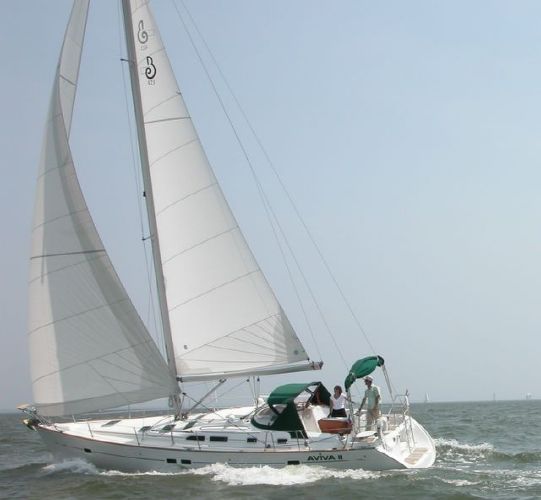
Beneteau 423 close reaching under a 140% jib and RF main


After pondering the alternatives and doing the math, we chose to go all the way and put a new rig in the boat. You're probably wondering why someone would take a perfectly good rig out of a boat and exchange it for something that is usually more work to set trim and douse. My answer is that RF mains work well for many things, but they can fail in ways that could be inconvenient at best and dangerous in some circumstances. They also can't deliver the performance that a full battened main can. In terms of danger, all you have to do is visit the B423 message board to read about a range of problems people have had with their RF main sails. Sails jammed in the slot, batten pockets torn, more jammed sails, maintenance issues on the furling system, etc. Don't misunderstand me, most B423 owners seem to love their RF main sails and have very few problems with them. But if you're planning for offshore cruising to remote places with a shorthanded crew, you want your rig to be 100% manageable in all conditions. So it's out with the furling rig.

As it turns out, we can do the conversion for a very reasonable price if we manage it well. US Spars, the company that built the original B423 rigs happens to have some mast extrusions left over from the production days, and agreed to build a new classic rig for us at a very attractive price. We found a local rigger here in SoCal who will take the old rig on consignment and we can surely sell the sail at Minneys, our local marine surplus store. So with the new rig, modifying the boom and buying a new mainsail, I estimate that the entire project will cost around $15.000.

423 with classic main and stackpack

We will include a 'Battcar' system, lazyjacks and a Stackpack to make sail handling easy. With full battens the sail falls neatly into the pack, eliminating the whole flaking exercise. More importantly, the sail can be reliably reefed in all conditions. I'll keep you posted on the progress for this project.

Mainsail neatly stowed. 

Tuesday, May 29, 2012

Beneteau 423 First Impressions

We took possession of our new 423 last weekend and renamed it 'Finisterra'. Yesterday we went for our first sail and finally had an opportunity to try the boat on all points of sail under power and under working sails. Here is a brief summary of what we discovered.


We left the slip in the downtown marina and took advantage of the flat water and light air in the turning basin to see how the boat maneuvers in forward and reverse. Finisterra is equipped with a Slipstream 3 bladed folding prop. We found that it operates smoothly when going from neutral into forward or reverse and provides plenty of thrust in forward. Outside the marina we saw 7 knots with the Yanmar diesel running at 2,200 RPM. Since it's a folding prop, it takes some throttle to get the boat moving when backing down, but overall performance is good. We had a three blade feathering prop on our last boat and it would occasionally snag some seaweed, so I think this prop is a good compromise for our purposes.

Sailing conditions were excellent with about 12 knots of breeze that built to about 16 in the afternoon. I unfurled the mainsail and I have to admit that it's awfully easy to operate the in-mast furling system. We puttered around under the mainsail only for half an hour. It's a tiny thing with a hollow leach and no battens but it has fairly good shape and pushed the boat along at about 5 knots in 15 knots of wind on a beam reach. I was pleased to see that it is in nearly new condition. With the 140% jib set, the boat came alive and we drove upwind with the apparent wind angle at about 40 degrees and about 7.5 knots of speed. Later, as we bore off to a close reach, the speed increased to about 8. Easing sheets a bit more, we put the boat on a beam reach and saw 8.5 on the knotmeter. Bearing off further brought the wind on the port quarter and our speed dropped as we expected. At all times the helm was light and well balanced, and perfectly responsive. Sailing back toward the marina the wind fell to about 5 knots as we approached the marina entrance and the boat ghosted along very nicely. I rolled up the jib and fired up the engine, then furled the mainsail just before entering the marina. All almost too easy. Our berth is near the head of the gangway and the fairway is narrow so it's a tight turn into our downwind slip but the boat maneuvered easily and we made our first landfall perfectly.

Having designed, built and sailed a number of racing yachts, I expect my boats to perform well. There is no need for a cruising boat to be a slug in terms of performance or handling and the B423 meets my expectations. I struggle with the idea of in-mast furling. I prefer the strength and simplicity of a full battened main and slab reefing and will likely convert this rig. Other than that, we're very pleased with the boat.